

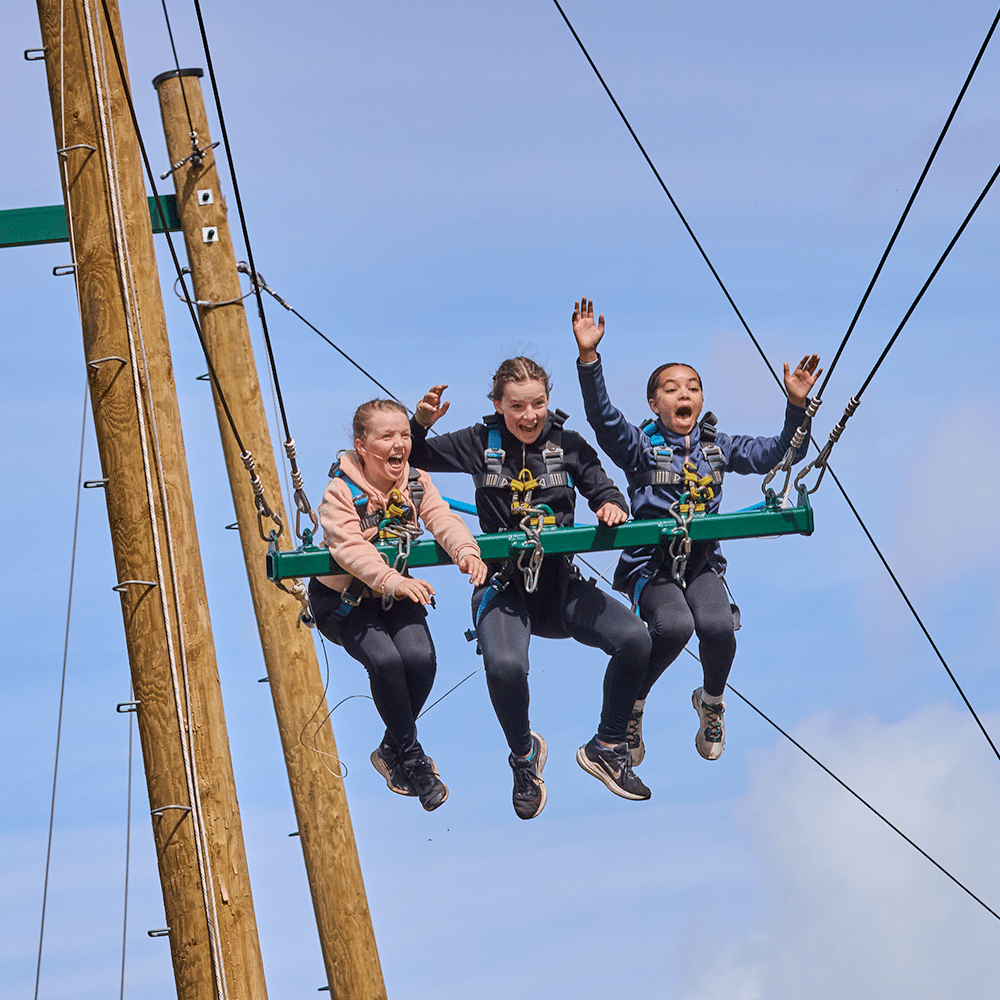
When it comes to building resilience in students, activities that encourage them to leave their comfort zone help to develop vital problem-solving, emotional strength and adaptability.
Set within the historic grounds of a former manor house, Grosvenor Hall in Kent houses one of Europe’s most extensive outdoor adventure facilities. From a nerve-wracking 3G swing to high-speed zip wires, adrenaline is at the very centre of this PGL retreat. Students have the opportunity to take on the ultimate aerial challenge, purposely designed to test limits and foster collaboration.
Not for the faint-hearted, this sky-high experience is designed to help students overcome personal fears while relying on their peers. Through a dynamic mix of independent challenges and group activities, participants learn that true resilience isn’t just about individual grit. It’s about the power of teamwork.
What Are High Ropes?
High ropes are aerial obstacle courses. Typically made up of platforms, bridges, balancing beams, swings, cargo nets and zip lines, they are usually around 20 to 60 feet in the air, making them a heart-pounding adrenaline experience.
The Benefits of High Ropes
High ropes, while incredibly fun, may also be very beneficial for a student’s development. This is because outdoor play is thought to positively contribute towards fundamental growth, development and wellbeing.
With elements of risk, bravery, uncertainty, exploration, personal challenge and adventure, studies have found that children partaking in outdoor experiences experienced positive associations across multiple developmental areas, including:
- Resilience and confidence
- Wellbeing
- Physical skills
- Autonomy and agency
- Nature and connectedness
- Quality play provision
- Educator influence
Together, these positive developmental associations combine to create the ideal high-risk, safe environment required to test limits and directly shape a student’s resilience.
How Do High Ropes Help to Build Resilience?
Stepping onto a high ropes course changes how students view challenges. By taking the learning out of the classroom and into the air, it provides them with experiences that turn abstract ideas into real, physical achievements.
These are just a few of the ways a high ropes adventure could help to build resilience:
- Self-Awareness: All the activities in the high ropes course allow students to set their own goals and limits. This enables them to focus on their strengths, take things at their own pace and tackle new challenges with confidence.
- Mindfulness and Self-Care: As with any new experience, the unknown can be daunting. High ropes teaches students to avoid acting impulsively in stressful situations, and instead take time to assess in order to achieve a more positive outcome.
- Perseverance: Obstacle courses are not designed to be easily accomplished. Through high ropes, students learn that failure isn’t final and that if they try, try and try again, success is within reach.
- Positive Outlook: Not everything always goes to plan, particularly in the great outdoors. From missing the trapeze bar to activities getting rained off, learning how to maintain a positive attitude in the face of disappointment is a valuable asset.
- Building Relationships: Teamwork is key to the high ropes as students rely on their peers and mentors to succeed. Establishing these connections of trust enables them to feel more confident asking for help and sharing burdens.
The Grosvenor Hall High Ropes Course
Set within 50 acres of educational and recreational facilities, the Grosvenor Hall school trip is designed to test students’ limits and build their confidence when faced with the challenge of the high ropes. Strictly supervised at all times by trained instructors, students explore the activities using safety harnesses and top-rope belays for a safe aerial adventure.
Learn the obstacles students can try to overcome during their stay:
3G Swing
Often referred to as a ‘giant swing’, the 3G swing takes a playground favourite up a level. Pulling two students high into the air, this swing then releases them with the pull of a cord in a rush of free-fall.
Skill Focus: Teamwork and peer support.
Jacob’s Ladder
Two to four students ascend a giant suspended ladder, aiming to reach the top. As they climb, the rungs get further apart, which means they must rely on their teammates to push or pull them up.
Skill Focus: Problem-solving, communication and teamwork.
The Leap of Faith
A classic aerial adventure, the leap of faith involves students climbing up to a platform before leaping off to catch a suspended trapeze bar.
Skill Focus: Building self-confidence, goal setting and overcoming fears.
Zip Wire
Students get to experience the rush of flying on the zip wire. Groups can glide over the park grounds before descending to the end of the line.
Skill Focus: Overcoming fear and peer support.
Low Ropes Course
If the high ropes seem a tad too daunting, the low ropes provide the perfect alternative. Closer to the ground, this course is designed to gently build familiarity with obstacles before progressing to more dizzying heights.
Skill Focus: Teamwork and overcoming fear.
Build Resilience Through Teamwork with PGL
Building resilience isn’t just about facing heights. It’s about navigating challenges together. A high ropes course provides the perfect arena to support this growth, but the environment is only as good as the team guiding it.
That is why we have a team of highly trained instructors on hand. Our expert staff know when to offer words of encouragement, how to manage group dynamics and how to safely encourage students out of their comfort zones to spark real development.
When planning your next adventure, choosing an experienced school trip provider is key. As a trusted provider, we also ensure that every safety measure, piece of equipment and learning outcome is expertly managed from start to finish.
Ready to see what your students can accomplish? Book your PGL stay at Grosvenor Hall and discover why we are the premier choice for high rope school trips